
ATO Copilot
ATO Copilot is a prototype for source-backed authorization support.
It started as a four-hour hackathon build at c0mpiled-10/DC: AI for Government, where it won 1st place. The project explored a narrow question:
Can AI help government teams move through authorization and compliance workflows by grounding every recommendation in source evidence?
What it does
ATO Copilot ingests synthetic evidence artifacts and produces structured control analysis.
The demo focuses on a few concrete tasks:
- mapping evidence to relevant control families
- surfacing likely reviewer questions
- identifying gaps or weak claims
- recommending next actions
- keeping outputs traceable to source material
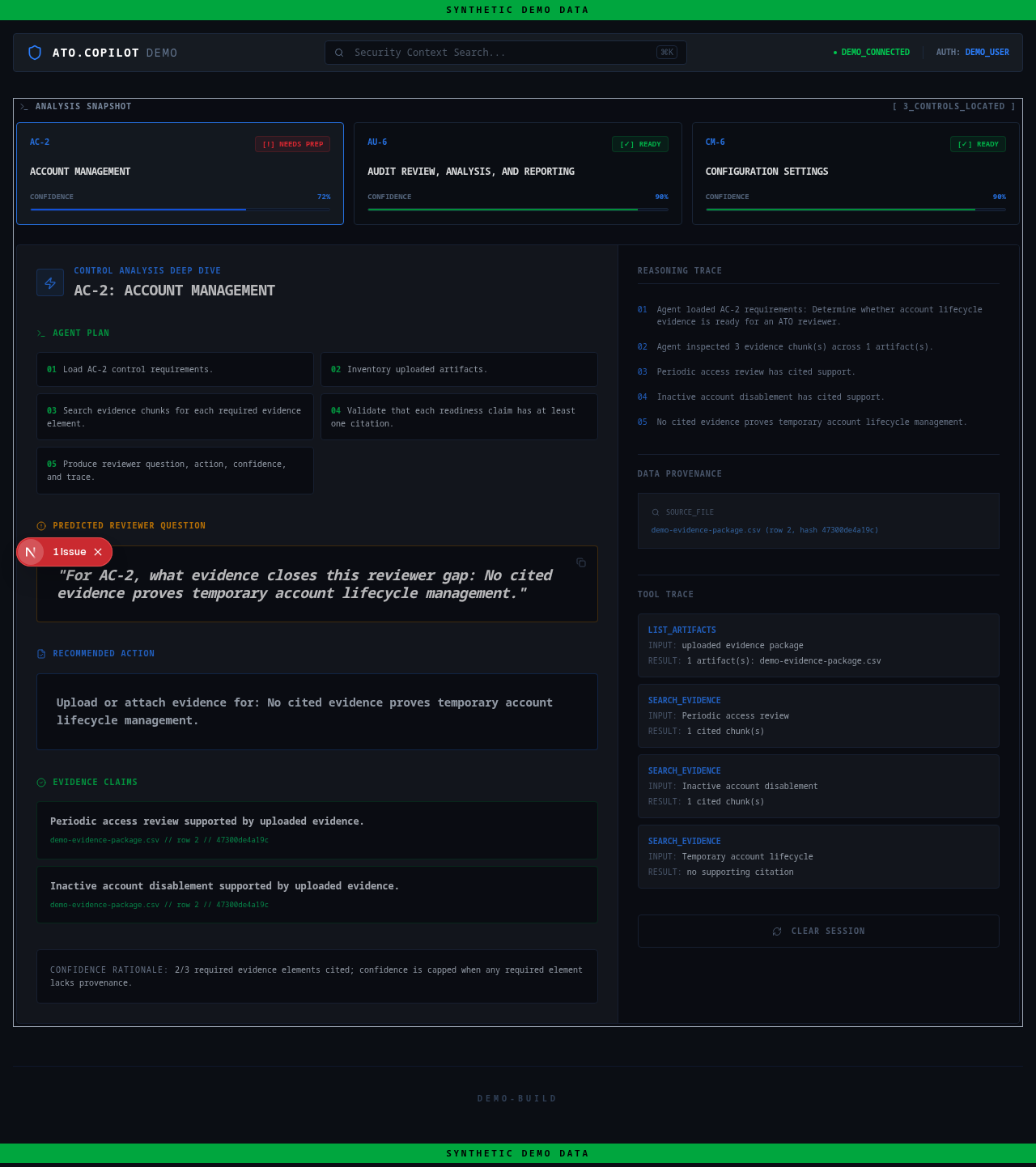
ATO Copilot demo interface using synthetic evidence. The screenshot shows source-backed control analysis, reviewer questions, recommended actions, and provenance traces.
Design principle
The important design choice is that the system is not a generic chatbot.
A blank chat interface asks the user to know what to ask. A compliance workflow needs the opposite: it should shape messy evidence into reviewer-ready work products. The interaction should start with artifacts and produce structured analysis, not start with a prompt box and hope the user interrogates the system correctly.
That is the difference between AI as an answer machine and AI as workflow infrastructure.
What it proves
High-trust AI systems should be:
- source-backed
- auditable
- constrained
- artifact-driven
- embedded in real approval paths
- designed around trust, not just speed
This is a prototype, not a production authorization system. All demo evidence is synthetic. It does not contain CUI, customer data, or official assessment output.